
Mining operations are becoming increasingly complex. Variability in ore characteristics, equipment condition, production requirements, energy consumption, environmental constraints, and safety risks creates a continuously changing operational environment.
At the same time, modern mines generate large volumes of data through IIoT sensors, fleet systems, SCADA/DCS, historians, laboratory systems, GIS platforms, maintenance applications, and enterprise systems.
The challenge is no longer simply collecting this data.
The challenge is turning it into contextualized operational intelligence that helps mining teams understand what is happening, identify why performance is changing, predict emerging issues, and act at the right time.
Mining is a highly interconnected system. A change in one part of the operation can influence several downstream processes.
For example, changes in ore characteristics can affect drilling and blasting requirements, fragmentation, material handling, crushing performance, grinding efficiency, recovery, energy consumption, and ultimately production output.
Similarly, equipment degradation can reduce availability, create bottlenecks, increase maintenance requirements, and affect production schedules.
Yet operational data is frequently distributed across different systems and functions.
Typical data sources include:
When these systems operate as disconnected information sources, teams may have visibility into individual processes without having a complete operational context.
Data fragmentation → Limited context → Delayed insight → Reactive decisions → Operational inefficiency
An intelligent mining environment aims to reverse this flow.
Intelligent mining connects data across key operational domains, enabling teams to move beyond isolated monitoring toward context-aware analysis, predictive insights, and continuous optimization.
Integrating geological models, GIS, exploration data, and geometallurgical information improve resource characterization and provides better inputs for mine planning and downstream decisions.
Combining drill parameters, blast design, rock characteristics, fragmentation, vibration, and production data can improve blast performance, fragmentation consistency, and downstream material handling.
Fleet and dispatch data—including cycle time, payload, utilization, idle time, fuel consumption, and queue time—can be analyzed to identify bottlenecks and improve material movement efficiency.
Correlating feed characteristics, throughput, energy consumption, particle size, and equipment condition helps identify process deviations and improve comminution performance and energy efficiency.
Connecting feed grade, recovery, throughput, reagent consumption, process parameters, and product quality enables deeper analysis of process behaviour and supports optimization of recovery, stability, throughput, and energy performance.
Integrating water, tailings, energy, environmental, and compliance data provides continuous visibility into operational and environmental performance while supporting earlier identification of deviations and risks.
Across each domain, the objective is the same:
Connect data → Contextualize conditions → Identify patterns → Predict risks → Optimize decisions
This creates an intelligence layer that connects operational performance rather than treating each mining function as an isolated system.
An intelligent mine requires more than dashboards.
It requires an architecture capable of connecting heterogeneous operational data and converting it into usable intelligence.
A simplified architecture can be represented as:
DATA SOURCES
IIoT • Edge Devices • SCADA • DCS • Historian • MES • ERP • GIS • Laboratory
↓
DATA INTEGRATION
Connect and normalize information from distributed operational systems.
↓
CONTEXTUALIZATION
Associate data with assets, processes, production states, locations, materials, and operational conditions.
↓
ANALYTICS & AI
Identify patterns, anomalies, correlations, deviations, and emerging risks.
↓
OPERATIONAL INTELLIGENCE
Convert analytical outputs into relevant KPIs, alerts, predictions, and recommendations.
↓
DECISION & ACTION
Enable production, maintenance, process, energy, and safety teams to respond based on current operational context.
This architecture creates a common intelligence layer between industrial data and operational decision-making.
Connecting systems is only the foundation. The greater value comes from contextualizing and interpreting data across assets, processes, production conditions, and operational constraints.
For example, a change in equipment vibration becomes more meaningful when correlated with load, operating speed, maintenance history, and production conditions. Similarly, a reduction in recovery can be evaluated alongside feed characteristics, throughput, process parameters, and energy consumption.
This contextual approach enables mining teams to move from simply monitoring individual parameters to understanding relationships, deviations, and performance drivers across the operation.
The intelligence progression
Connect → Contextualize → Analyze → Predict → Act
The result is a shift from isolated data visibility toward decision-oriented operational intelligence
AI and advanced analytics can extend mining intelligence from descriptive monitoring to anomaly detection, prediction, and optimization.
Anomaly Detection
Identify deviations from expected operating behaviour across equipment, processes, and production parameters.
Predictive Maintenance
Analyze condition signals, historical behaviour, and maintenance data to identify emerging degradation and potential failure risks.
Process Optimization
Correlate process variables to identify conditions influencing throughput, recovery, quality, stability, and energy performance.
Production Intelligence
Analyze operational constraints, equipment availability, material characteristics, and production data to support more informed scheduling and resource allocation.
Energy Intelligence
Identify consumption patterns and operational conditions associated with excessive energy use, supporting opportunities for energy efficiency and process optimization.
The role of AI is therefore not simply to automate analysis. It is to help convert complex operational datasets into earlier insights, risk indicators, and actionable recommendations.
Traditional mining operations often rely on periodic reporting, manual analysis, and function-specific decision-making. A connected intelligence approach enables a more continuous decision cycle.
Instead of:
Monitor → Report → Review → Respond
operations can move toward:
Sense → Understand → Predict → Act → Learn
Real-time operational signals provide visibility into changing conditions. Analytics identify deviations and performance patterns, while predictive models help anticipate potential risks or changes. These insights can then support maintenance, production, process, energy, and operational decisions.
The feedback from executed decisions and resulting performance can subsequently strengthen the intelligence cycle, creating a foundation for continuous operational optimization rather than one-time analysis.
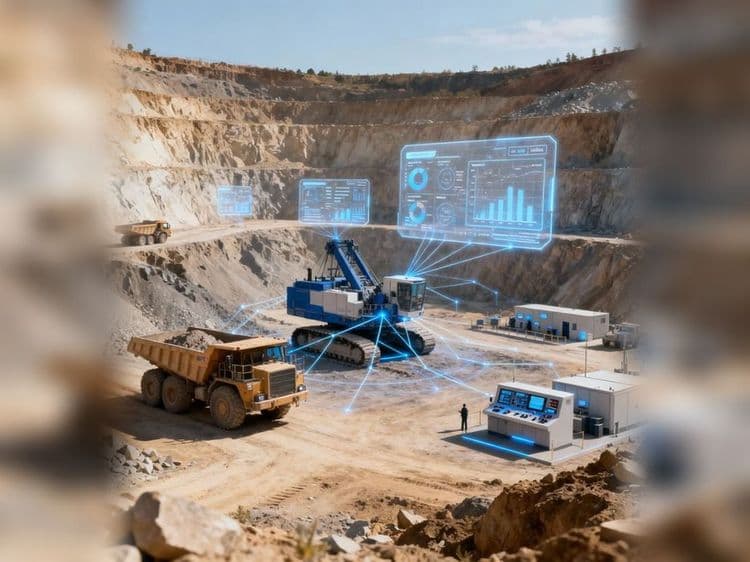
DaVinci connects IIoT, operational, production, maintenance, process, and enterprise data into a contextualized intelligence layer. By combining real-time signals with operational context, analytics and AI can identify patterns, detect emerging risks, and support predictive decision-making. This enables teams to move from isolated monitoring toward coordinated, data-driven actions across mining operations. The focus is not simply on collecting data, but on turning it into actionable operational intelligence.
From fragmented data → Contextualized intelligence → Better decisions → Continuous optimization.